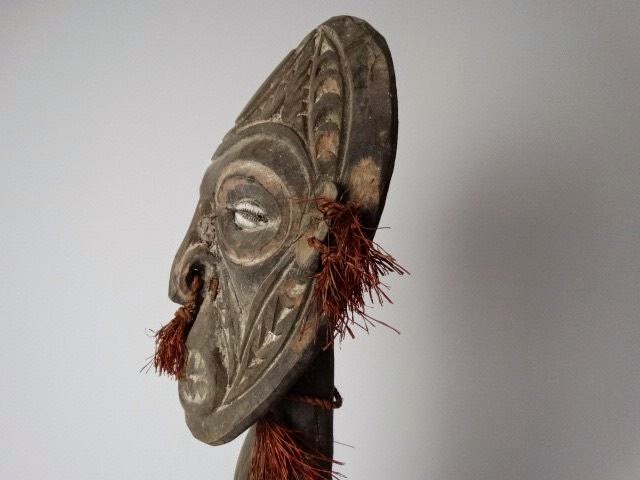
Papua New Guinea including the Indonesian invaded and occupied West Papua (Irian Jaya) has always held a special place in my heart.
This piece has pride of place in my collection.
The Asmat are an ethnic group of New Guinea, residing in the Papua province of Indonesia. The Asmat inhabit a region on the island's southwestern coast bordering the Arafura Sea, with lands totaling approximately 18,000 km² (7,336 mi²) and consisting of mangrove, tidal swamp, freshwater swamp, and lowland rainforest.
The land of Asmat is located both within and adjacent to Lorentz National Park and World Heritage Site, the largest protected area in the Asia-Pacific region. The total Asmat population is estimated to be around 70,000. The term "Asmat" is used to refer both to the people and the region they inhabit.
My own interest in the Asmat began a long time ago. I would have been all of 8 years old when a story in our newspapers here in Sydney were full of news of an expedition to try and find out what happened to Michael Rockefeller who had disappeared in the western provinces in the early 1960's whilst on a art gathering expedition for the Rockefeller Museum.
Michael Rockefeller
I schooled with girl from PNG and Papua and when I asked them...some smiled, some laughed and one lass from the lower Lorenz area ran her finger across her throat and said 'Rockefeller him blong Asmat, save?' How she knew I never found out.
I am fluent in Tok Tok Pisin and I was intrigued. (Later Philomena became a Nun with the Sisters of Mercy - a strange juxtaposition culturally in my eyes).
It is now believed that the Asmat killed him, took his head and cannibalized him. Not to 'eat' you understand - but take into them the 'spirit' of Rockefella himself. The had seen the power of him already.
The Asmat believe that death occurs only through magic or murder. Spirits of the dead demand vengeance. Only through the death of an enemy are spirits of the murdered individual appeased and leave the land of the living for the land of the dead. Only through death can life begin.
During the initiation ceremony of an Asmat boy,the initiate sits for three days with the decapitated head of an enemy at his groin, absorbing the dead man's essence through his penis. He then begins the rites of passage that take him to manhood.
All carvings in Asmat are named for the dead and are meant to remind the living of their obligation to avenge the murders. Every object, every spear, drum, paddle, food bowl, housepost, carrying bag, bamboo horn - everything the Asmat make, in fact - is named for a person who has recently died, whose spirit will remain in the village until vengeance has been taken.
Many carvings are made for specific rituals. Great ancestor poles are carved for headhunting and initiation rites among the Bisman people of the coast. Other areas have equally complex ritual objects, such as the immense soul ships of the Simai people. Each of the five main Asmat areas had its own initiation ceremonies that demand specific carvings.
The human skulls that had been taken in battle may not simply be strung together but each skull must be knotted individually onto the single cord. The cord is then hung close to the doorway. When a head is broken or decay, they make a replacement so that the aura of the person (spirit) lives on.
This then is a replacement head circa 1970 of a head taken in battle.
The items attached to it also have significance as does the cassowary bones and feathers. The cassowary is sacred to the Asmat people and the head that have these attached have special significance.